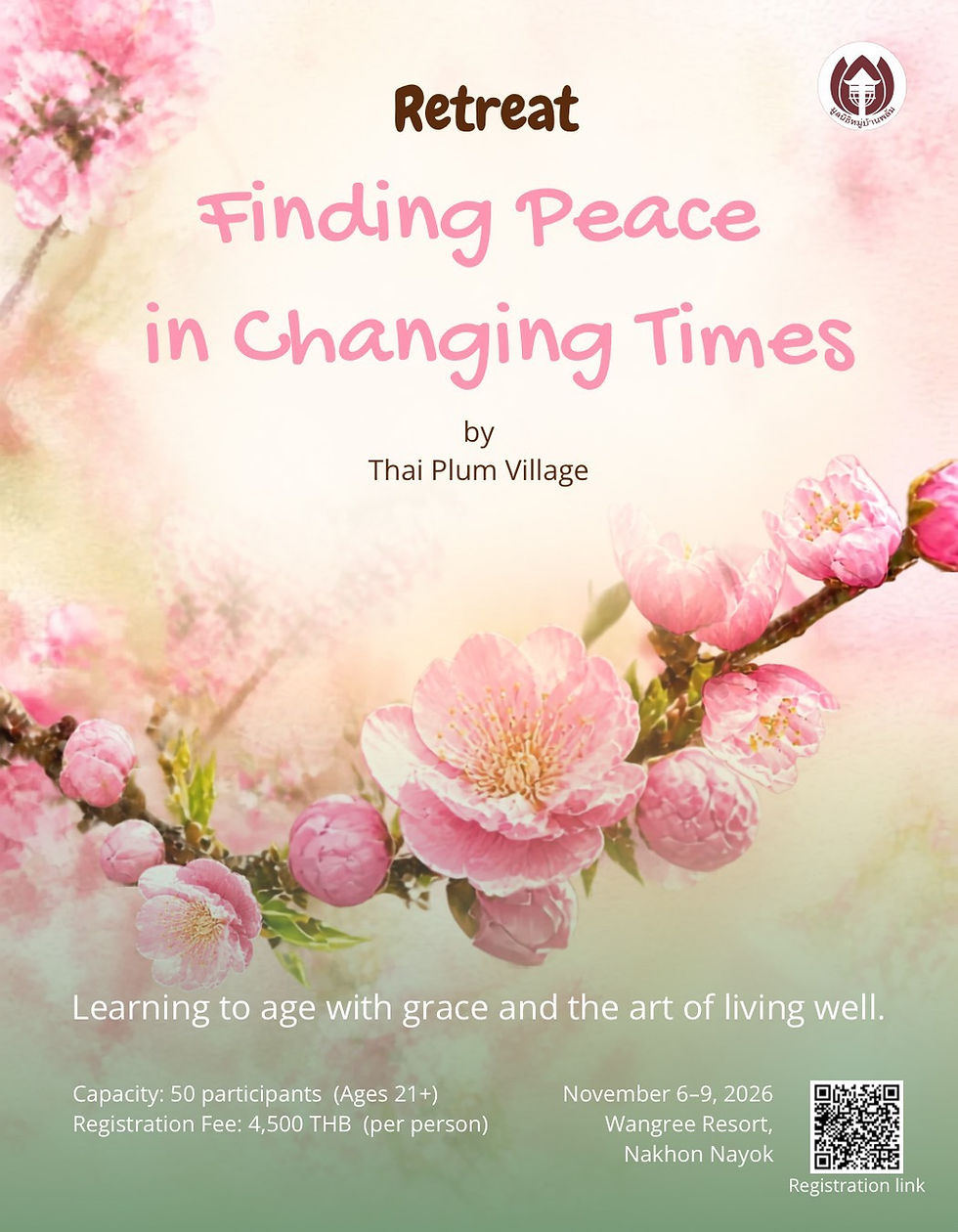
When I Became Present to All Things, I Found God in All Things
When I Became Present to All Things, I Found God in All Things
An Ignatian Encounter with Plum Village
The bell rang, and everybody stopped moving.
The brother monk who was showing me around Plum Village suddenly fell silent. I stood there, completely confused. What was I supposed to do? Close my eyes? Pray? Before I could figure it out, he was back with a smile. “You’ll get used to it. Welcome to Plum Village.”
I had come here to spend a few days with the Buddhist monks: to eat, to sit, to learn.
At Plum village, whenever the bell sounded, a spoon paused halfway to the mouth. A conversation fell silent. Someone glued to a laptop or phone screen closed their eyes or simply looked away. Feet stopped walking. Hands became still. What surprised me was the ease of it. No frowning. No irritation. No sense that precious seconds were being wasted.
Less than a minute later, life simply resumed. The invitation: just become present to the present.
Notice the breath. Notice the body. Notice what is happening within. Gather yourself. Return to yourself – to the moment you are actually living here and now.
Simple.

So, what began as a moment of confusion soon became, at least for my first couple of days, a fascinating exercise in observation, and today, a practice I would gladly emulate.
As a Jesuit, I had spent years learning to see the world through one of Ignatius’ most beautiful lenses: to “find God in all things.” The Spiritual Exercises form us into that way of seeing through weeks of silence and seclusion, hours of prayer, meditation on Scripture, imaginative contemplation, the Examen and constant discernment of what moves within us. They are not meant simply to teach ideas about God, but to cultivate in us a sensus Christi, a way of seeing and living with the mind and heart of Christ.
This vision reaches a beautiful climax in the Contemplation to Attain Love. God is not confined to the chapel, the retreat house or the mountaintop. God is transcendent, certainly, but never distant. God is also immanent, present here and now, in the market, at the table, in work, conversation, creation and the ordinary mess of everyday life. More than merely present, God is dwelling and labouring within creation, continually giving life. And that includes me.
Retreat insights are beautiful in silence. The real test is whether they survive the chaos and confusion of daily life, with WhatsApp, Instagram, deadlines, constant firefighting and a multitude of distractions adding fuel to the fire. So the real challenge is: How does one actually live out this, or in other words, how does one “find God in all things” on an ordinary Tuesday?
Certainly, the Examination of Consciousness, or Examen, offers one way. We pause, look back, notice where life was stirring, and ask where God was present and how awake we were to that presence. But the bell added something to this. It brought tiny Examen moments all through the day. All it did was interrupt the autopilot, break the rush, and draw me back to the present moment. Simply to be here, to be now, to be present.
The second insight that stayed with me was inter-being. Thich Nhat Hanh’s term grows out of the Buddhist teaching of dependent origination, pratītyasamutpāda in Sanskrit and paṭiccasamuppāda in Pali. Put simply: this is because that is. Nothing comes into being entirely by itself.
It sounds philosophical until you look at your lunch.
The vegetables on my plate were no longer just carrots or beans. In them were soil, rain, sunlight, farmers, transport, cooks and countless hands. The whole world had quietly arrived in front of me. Suddenly I was seeing a living web of inter-connected relationship and mutual dependence: earth and food, body and breath, self and neighbour, labour and gift, creature and Creator.
And then a prayer I had recited countless times as a Catholic priest resounded in my heart: “Blessed are you, Lord God of all creation, through your goodness we have received the bread we offer you. It is the fruit of the earth and work of human hands and may it become for us the bread of life.”
At Plum Village, those familiar words returned with a freshness I did not expect. I had prayed them for years; now I was beginning to feel them.

Inter-being became even more tangible through people. In conversations with the monks and practitioners from different parts of the world, I often sensed a connection that was difficult to explain. We came from different countries, languages, religions and histories. Yet sitting together, listening to one another, or sharing silence over a simple cup of tea became a sacred moment of connection.
I began to understand that inter-being doesn't mean we become the same, but that we are never entirely separate.
This brought me back to Ignatius. He does not speak of inter-being, and the two traditions understand the self, creation and ultimate reality differently. Yet something resonated deeply. If God is dwelling and labouring in all of this, creation is not simply a collection of things around me. It is gift received through interconnected relationship.
Inter-being helped me notice how everything is interconnected; the Spiritual Exercises helped me receive that connection as gift. "Finding God in all things" began to feel less like locating God here and there, and more like waking up to relationships already held together in God.
But inter-being carried an uncomfortable consequence: if we truly belong to one another, another person's suffering can never remain entirely "their problem." Thich Nhat Hanh had learnt this. During the war in Vietnam where young monks and nuns faced a hard question: should they stay in the monastery and meditate, or go out and help the wounded? Thay's answer was that they must do both. Out of that experience came what he called Engaged Buddhism.
Engaged Buddhism spoke strongly to my Christian and Ignatian formation. Mindfulness is not meant to become an escape into private peace, another stress buster, or a refined form of navel gazing. If attention is genuine, it eventually becomes compassion. And compassion, sooner or later, calls for action.
For a Christian, that concern reaches every suffering creature, but it has a particular pull toward those pushed to the margins: the poor, the excluded, the discriminated, the exploited, and our wounded earth.
Yet even working for justice has its traps. Anger at injustice can quietly become hatred. Generous service can secretly feed the ego. I can become wonderfully busy doing God’s work and, with considerable efficiency, forget God. So, the question remains: from what place within me does my action arise?
Here Buddhist non-attachment and Ignatian interior freedom began another conversation within me. Can I care deeply without possessing? Can I act passionately without creating new divisions? Can I listen without already preparing my reply?
My days at Plum Village did not convince me that Buddhism and Christianity are saying the same thing. They are not, and they need not be. What happened was far more personal. A bell, a plate of vegetables, a few monks, shared cups of tea and long moments of silence sent me back to Christ with a renewed heart.
I eventually left Plum Village, but somehow the bell came with me through my ordinary Tuesdays. Now and then, in the middle of rushing, eating, talking, working or worrying, I remember its invitation: stop, notice, return.
Perhaps God is never difficult to find. Perhaps all I need is to be present.
And now I know a little more deeply what I had heard for years: when I become present to all things, I find God in all things.